Quantum Tunneling: How Particles Cheat the Coulomb Barrier to Power the Sun and Drive Radioactivity
If the universe operated strictly according to the rules of classical Newtonian mechanics, our world would look radically different: the Sun would never have ignited, stars would not shine, and heavy radioactive elements would never undergo alpha decay.
At the heart of both stellar nuclear fusion and radioactive decay lies a formidable electrostatic wall known as the Coulomb Barrier. In classical physics, two positively charged atomic nuclei approaching each other require immense kinetic energy to overcome their electrostatic repulsion and touch. In the core of our Sun, however, protons possess less than 1% of the kinetic energy classically required to cross this barrier.
Yet, the Sun burns brightly, fusing 600 million tons of hydrogen every single second.
How do particles bypass an energy barrier they do not possess the energy to climb? The answer is Quantum Tunneling—a fundamental consequence of the wave nature of matter. In this post, we will explore how quantum tunneling works from first principles, break down the physics of the Coulomb barrier, and examine how tunneling governs both the cosmic engines of nuclear fusion and the subatomic clocks of radioactive decay.
1. The Classical Impossibility: The Great Repulsion
To fuse together, two approaching protons must overcome their mutual electrostatic repulsion to reach the critical nuclear radius (R₀ ≈ 1.4 fm) where the attractive Strong Nuclear Force takes over:
   [ Proton + ] ──────────────►            ◄────────────── [ Proton + ]
                    Repulsion grows violently as r → 0
This interaction creates a steep electrostatic hill known as the Coulomb Barrier:
       Potential Energy V(r) [MeV]
                ▲
                │         Coulomb Barrier Peak (V_max ≈ 1.25 MeV)
                │                /│\
                │               / │ \   Coulomb Repulsion ~ 1/r
                │              /  │  \
                │             /   │   \───────► Particle Energy E ≈ 0.0013 MeV
                │            /    │    \        (Classically Forbidden Zone)
                │           /     │     \
  ──────────────┼──────────┴──────┴──────┴─────────────────────► Radial Distance r
                │   r < R_0│      │
                │          │      │
    Attractive  │ ┌────────┘      └────── Classical Turning Point (r_turn)
   Nuclear Well │ │
    (~ -30 MeV) │ └──────────────────── Strong Nuclear Attraction Zone
                ▼
The Immense Energy Deficit
To see why classical physics fails completely, consider the sheer scale of the energy mismatch inside the Sun:
┌─────────────────────────────────────────────────────────────────────────────┐
│                     THE ENERGY MISMATCH AT A GLANCE                         │
├─────────────────────────────────────────────────────────────────────────────┤
│                                                                             │
│  Coulomb Barrier Height (Needed for classical fusion)                       │
│  ██████████████████████████████████████████████████  ~ 1,000 keV (1.0 MeV)  │
│                                                                             │
│  Solar Thermal Energy (What protons actually have in Sun's core)            │
│  ▌ ~ 1.3 keV  (Protons are underpowered by nearly 1,000x!)                  │
│                                                                             │
└─────────────────────────────────────────────────────────────────────────────┘
  [ Classical Physics Prediction ]             [ The Observed Reality ]
  ────────────────────────────────             ────────────────────────
  • Required Energy: ~ 1,000 keV (1 MeV)       • Average Thermal Energy: ~ 1.3 keV
  • Chance of reaching 1 MeV: ~ 10⁻³³⁴         • Available Protons: ~ 10⁵⁷
  • Predicted Outcome: Cold, Dead Star         • Actual Outcome: 10 Billion Years of Light!
Classically, the chance of a proton possessing enough thermal velocity to climb this wall is roughly 10⁻³³⁴—indistinguishable from zero. In the entire mass of the Sun, not a single proton would ever have sufficient classical energy to scale the barrier.
Under classical mechanics, the Sun should be pitch black.
2. The Quantum Solution: Wave Nature & Evanescent Waves
In quantum mechanics, particles are not solid billiard balls with rigid boundaries. Instead, every particle is described by a wave of probability.
When a quantum wave encounters an electrostatic barrier it cannot classically overcome, it does not bounce back instantly. Instead, it enters the barrier as an exponentially decaying (evanescent) wave:
┌─────────────────────────────────────────────────────────────────────────────┐
│                    THE THREE ZONES OF QUANTUM TUNNELING                     │
├─────────────────────────────────────────────────────────────────────────────┤
│                                                                             │
│  [ ZONE 1: Approach ]      [ ZONE 2: The Barrier ]     [ ZONE 3: Inside ]   │
│   Free Oscillating Wave     Exponential Decay           Transmitted Wave    │
│                                                                             │
│       ∿∿∿∿∿∿∿∿∿∿           ╲                           ∿∿                  │
│       High amplitude        ╲_ Evanescent leakage       Fused state         │
│                                                                             │
│   • Particle approaches     • Energy < Barrier Height   • Barrier crossed!  │
│   • Free oscillation        • Amplitude decays steeply  • Non-zero chance   │
│   • Classically allowed     • Classically forbidden     • Bound in nucleus  │
│                                                                             │
└─────────────────────────────────────────────────────────────────────────────┘
Because the Coulomb barrier is finite in thickness, the decaying wave does not drop to zero before reaching the other side. A small, surviving portion emerges directly inside the nuclear well:
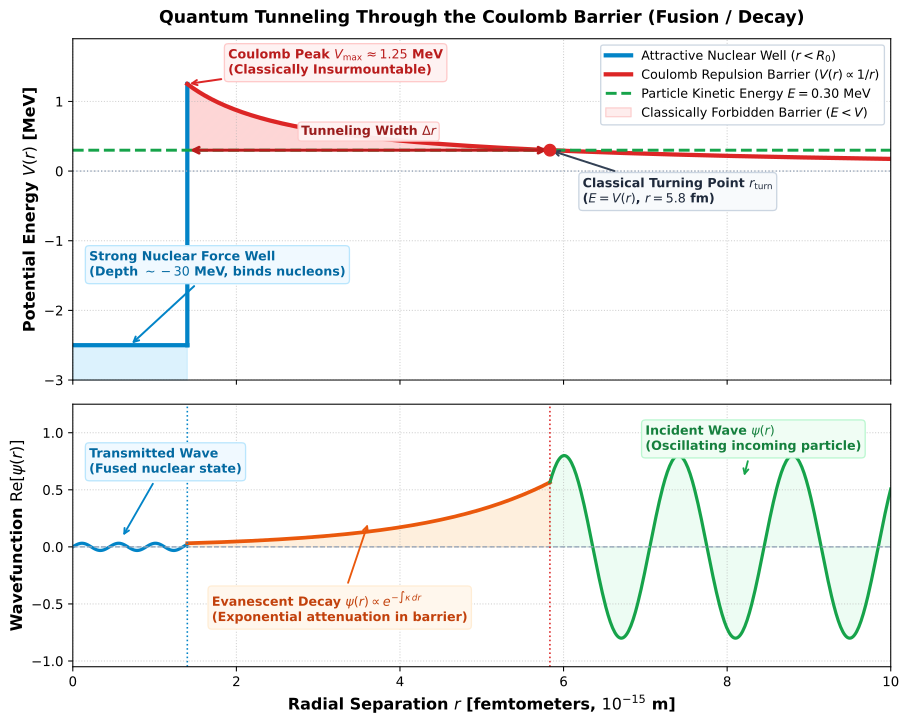
The Tunneling Probability: Why Barrier Width Matters
The thicker the electrostatic barrier, the more the quantum wave decays before reaching the other side. When protons collide with higher kinetic energy, they push deeper into the Coulomb slope before bouncing, which dramatically narrows the distance they must tunnel:
┌─────────────────────────────────────────────────────────────────────────────┐
│               HOW PARTICLE ENERGY SHRINKS THE BARRIER WIDTH                 │
├─────────────────────────────────────────────────────────────────────────────┤
│                                                                             │
│  [ LOW ENERGY COLLISION (~ 1 keV) ]                                         │
│   Incoming Proton ──► (Stops early)                                         │
│   Barrier Width:     |◄──────────────── WIDE ────────────────►|             │
│   Decaying Wave:     ∿∿∿ ╲___________________________________ (Vanishes)    │
│   Tunneling Chance:  Practically Zero (~ 1 in 10²⁰)                         │
│                                                                             │
│  ─────────────────────────────────────────────────────────────────────────  │
│                                                                             │
│  [ HIGHER ENERGY COLLISION (~ 10 keV) ]                                     │
│   Incoming Proton ────────────► (Pushes deep into the slope)                │
│   Barrier Width:     |◄── NARROW ─►|                                        │
│   Decaying Wave:     ∿∿∿∿∿∿∿∿ ╲_ ∿∿ (Survives into nucleus!)                │
│   Tunneling Chance:  Surges by Billions of Times!                           │
│                                                                             │
└─────────────────────────────────────────────────────────────────────────────┘
  [ Low Energy: 1 keV ]                        [ Optimal Energy: 10 keV ]
  ─────────────────────                        ──────────────────────────
  • Barrier is thick & impenetrable            • Barrier is thin & permeable
  • Wave decays to zero                        • Wave amplitude survives
  • Tunneling Probability: ~ 10⁻²⁰             • Tunneling Probability: Boosted 10¹⁰x!
This explains why tunneling probability surges exponentially with energy—giving rise to the Gamow Factor:
\[P_{\text{tunnel}}(E) \approx \exp\left( - \sqrt{\frac{E_G}{E}} \right)\]3. Case 1: Tunneling Inward — How the Sun Burns (The Gamow Peak)
In stellar nucleosynthesis, nuclear fusion is not driven by the highest-energy particles (which are too rare) nor by the average-energy particles (which have virtually zero tunneling chance). Instead, fusion takes place in a finely tuned sweet spot called the Gamow Peak.
The overall fusion reaction rate at a given energy is proportional to the product of two opposing physical functions:
- Maxwell-Boltzmann Thermal Distribution: At low energies (~ 1 keV), particles are abundant, but the population drops exponentially as energy increases.
- Quantum Tunneling Probability: At low energies, tunneling is virtually zero, but rises exponentially as energy increases because higher particle energy shrinks the effective barrier width.
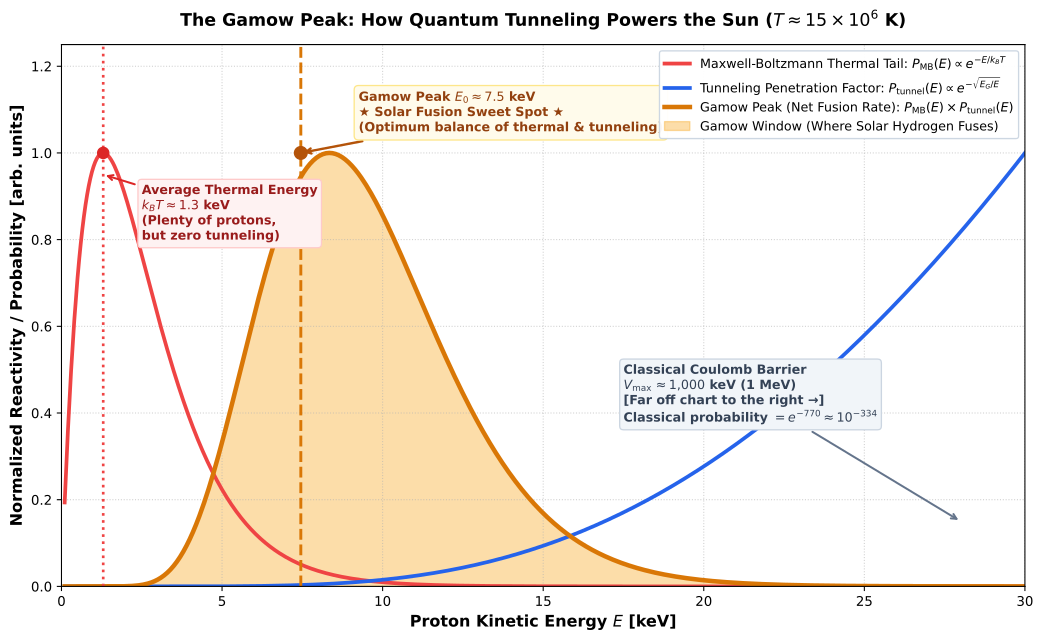
The Gamow Window
Multiplying these two opposing curves produces a sharp, localized resonance known as the Gamow Peak:
\[I(E) = P_{\text{MB}}(E) \times P_{\text{tunnel}}(E) \propto E \exp\left( -\frac{E}{k_B T} - \sqrt{\frac{E_G}{E}} \right)\]For the proton-proton chain in the core of our Sun (temperature ≈ 15 million K, thermal energy ≈ 1.3 keV), the optimal fusion energy is centered at:
\[E_0 \approx \mathbf{7.5\text{ keV}}\]The “Stellar Thermostat”: Why the Sun Doesn’t Explode
At 7.5 keV, the tunneling probability for a given proton collision is still tiny—roughly 1 in 10⁹ to 10¹⁰.
Furthermore, once two protons tunnel together to form a temporary diproton (²He), it almost always instantly flies apart unless a simultaneous weak-force interaction converts one proton into a neutron (p + p → d + e⁺ + νₑ). The overall probability of a fusion event per proton collision is a staggering 1 in 10²⁸.
On average, a single proton in the Sun waits roughly 9 billion years before successfully fusing with a neighbor!
This minuscule quantum probability is precisely what makes life on Earth possible:
- If tunneling were slightly easier, stars would consume all their nuclear fuel in minutes, exploding like giant thermonuclear bombs.
- If tunneling were impossible, stars would never ignite in the first place.
- The steep exponential sensitivity of the Gamow peak acts as a self-regulating gravitational thermostat: if the core contracts and heats up, fusion rates increase, generating thermal pressure that expands and cools the core back to equilibrium.
4. Case 2: Tunneling Outward — Radioactivity & Alpha Decay
Quantum tunneling is not only an “inward” mechanism for fusion; it also operates in reverse as an “outward” escape hatch in radioactive alpha decay:
  [ NUCLEAR FUSION: Tunneling Inward ]       [ ALPHA DECAY: Tunneling Outward ]
  ────────────────────────────────────       ──────────────────────────────────
   Approaching Proton                         Trapped Alpha Particle
         ──► [ Barrier ]                            [ Barrier ] ──► Escapes!
   Must penetrate INTO the nucleus            Must tunnel OUT OF the nucleus
In heavy radioactive nuclei (such as Uranium, Radium, and Polonium), an alpha particle (a Helium-4 nucleus: 2 protons and 2 neutrons) is trapped inside the nuclear well:
┌─────────────────────────────────────────────────────────────────────────────┐
│                    THE ALPHA DECAY TRAP & ESCAPE MECHANISM                  │
├─────────────────────────────────────────────────────────────────────────────┤
│                                                                             │
│   NUCLEAR WELL (Strong Force)        COULOMB WALL (Repulsion)   FREE SPACE  │
│                                                                             │
│   [ ◄── ∿∿∿∿∿∿∿∿ ──► ]                  |██████████████|                    │
│   Trapped Alpha Particle                |    Barrier   |    ∿∿              │
│   Bounces ~ 10²¹ times / sec!           |  Penetration |   Escaping Alpha   │
│   Energy: 4 to 9 MeV                    |  Wall: 30 MeV|   Particle!        │
│                                                                             │
└─────────────────────────────────────────────────────────────────────────────┘
Inside the nucleus, the alpha particle moves at extreme speed, colliding with the inner barrier wall roughly 10²¹ times per second.
Classically, the barrier wall (25 to 30 MeV) is far higher than the alpha particle’s energy (4 to 9 MeV), making escape impossible. But in quantum mechanics, each collision offers a tiny chance to tunnel outward into free space.
The 24-Order-of-Magnitude Sensitivity
Because higher alpha energy narrows the barrier thickness, the tunneling probability surges exponentially. A mere 2× increase in alpha energy speeds up decay by 10²⁴ times:
┌─────────────────────────────────────────────────────────────────────────────┐
│             THE GEIGER-NUTTALL SENSITIVITY: 2x ENERGY = 10²⁴x SPEED         │
├─────────────────────────────────────────────────────────────────────────────┤
│                                                                             │
│  Thorium-232 (4.01 MeV Alpha)                                               │
│  Barrier: WIDE   → Half-Life: ████████████████████  14.0 Billion Years      │
│                                                                             │
│  Radium-226 (4.78 MeV Alpha)                                                │
│  Barrier: Medium → Half-Life: █████  1,600 Years                            │
│                                                                             │
│  Polonium-212 (8.78 MeV Alpha)                                              │
│  Barrier: THIN   → Half-Life: ▏ 0.30 Microseconds (300 nanoseconds!)        │
│                                                                             │
└─────────────────────────────────────────────────────────────────────────────┘
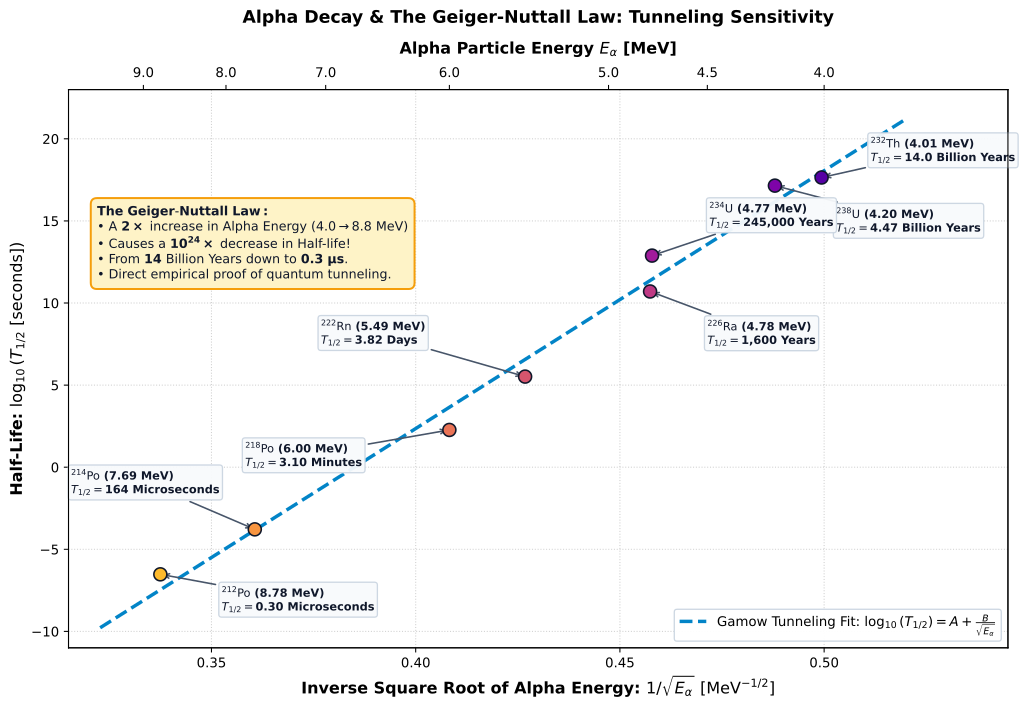
| Isotope | Alpha Energy (E_α) | Half-Life (T₁/₂) | Half-Life in Seconds | log₁₀(T₁/₂ [s]) |
|---|---|---|---|---|
| Thorium-232 (²³²Th) | 4.01 MeV | 14.0 Billion Years | 4.4 × 10¹⁷ s | +17.6 |
| Uranium-238 (²³⁸U) | 4.20 MeV | 4.47 Billion Years | 1.4 × 10¹⁷ s | +17.1 |
| Uranium-234 (²³⁴U) | 4.77 MeV | 245,000 Years | 7.7 × 10¹² s | +12.9 |
| Radium-226 (²²⁶Ra) | 4.78 MeV | 1,600 Years | 5.0 × 10¹⁰ s | +10.7 |
| Radon-222 (²²²Rn) | 5.49 MeV | 3.82 Days | 3.3 × 10⁵ s | +5.5 |
| Polonium-218 (²¹⁸Po) | 6.00 MeV | 3.10 Minutes | 186 s | +2.3 |
| Polonium-214 (²¹⁴Po) | 7.69 MeV | 164 Microseconds | 1.64 × 10⁻⁴ s | -3.8 |
| Polonium-212 (²¹²Po) | 8.78 MeV | 0.30 Microseconds | 3.0 × 10⁻⁷ s | -6.5 |
This exponential relationship forms the celebrated Geiger-Nuttall Law:
\[\log_{10}(T_{1/2}) = A + \frac{B}{\sqrt{E_\alpha}}\]George Gamow’s 1928 tunneling explanation of this law provided one of the earliest and most definitive proofs of quantum mechanics.
5. Synthesis: Two Sides of the Same Quantum Coin
Although nuclear fusion and alpha decay seem like opposite phenomena—one forging heavier elements in the hearts of stars, the other disintegrating heavy elements in terrestrial rocks—they are two symmetrical expressions of the exact same quantum equation:
| Feature | Nuclear Fusion (Inward Tunneling) | Alpha Decay (Outward Tunneling) |
|---|---|---|
| Direction | Inward (from free space into the nucleus) | Outward (from inside the nuclear well into free space) |
| Barrier Origin | Electrostatic Coulomb repulsion between positive nuclei | Electrostatic Coulomb wall trapping the pre-formed alpha particle |
| Energy Level | ~ 1 to 25 keV (Thermal / Gamow window) | ~ 4 to 9 MeV (Bound alpha state) |
| Barrier Height | ~ 0.5 to 1.5 MeV | ~ 25 to 30 MeV |
| Key Formula | Gamow Peak: Optimal energy E₀ ≈ 7.5 keV | Geiger-Nuttall Law: log₁₀(T₁/₂) = A + B / √E_α |
| Cosmic Consequence | Powers stars, manufactures all elements up to iron, creates light | Drives geothermal heat in planetary mantles, powers radiometric dating |
6. Summary & Key Takeaways
- The Coulomb Barrier Problem: Positively charged nuclei repel each other via Coulomb’s law. In both fusion and alpha decay, particles lack the classical energy required to surmount this peak.
- Evanescent Wave Penetration: Because matter exhibits wave-particle duality, the quantum wave inside a barrier decays exponentially rather than abruptly dropping to zero. If the barrier is thin enough, a non-zero probability amplitude emerges on the opposite side.
- The Gamow Window Powers Stars: Fusion in the Sun occurs at the intersection between the falling Maxwell-Boltzmann thermal tail and the rising tunneling probability function. This narrow peak (~ 7.5 keV) allows stars to burn steadily over billions of years.
- Geiger-Nuttall Exponential Scaling: In alpha decay, because tunneling transmission depends exponentially on 1 / √E_α, a 2-fold change in alpha particle energy yields a 24-order-of-magnitude change in half-life.
Without quantum tunneling, matter would remain frozen in its simplest forms, the cosmos would be pitch black, and the elements necessary for chemistry and life would never have been synthesized.